Response to Catholic State

Recently, a YouTuber named Justin who goes by the moniker of Catholic State put out a video responding to my response to the so-called Coalition of Catholics Against Jewish Supremacy. Catholic State had offered to debate me around a year and a half ago, but I declined to do so because at the time I thought he was not a good faith actor. For example, at the time he put out AI song parodies about things like Jews turning Christian children into matzo ball soup. I understand the internet has turned all of our brains into mush, but it seemed to me a reasonable conclusion that I would not get anywhere with such a discussion. However, since then, Catholic State has become more professional, and so now I feel he is worth engaging. In his videos on this whole controversy, he has repeatedly acknowledged where he thinks I have gotten things right and given me credit, which I do appreciate. I try to engage back with good faith criticism. Thus, I will reply point by point to his video.
Response to “error” 1: Justin accuses me here of treating Nostra aetate has dogmatic when it was only pastoral. However, we owe a religious submission of intellect and will even to non-dogmatic Church teachings. Justin argues that we should instead prioritize dogmatic definitions, most notably here Cantate Domino of the Council of Florence. To his credit, Justin does accept Nostra aetate and simply reads it with a hermeneutic of continuity. However, I also accept both these Church teaching and likewise accept a hermeneutic of continuity.
The reason I did not bring up Cantate Domino in my response to the students is that they did not invoke Cantate Domino, nor did they argue for a hermeneutic of continuity. Instead, they explicitly rejected to the authority of the Nostra aetate as they insist the document itself contradicts scripture. See their second objection:

If Justin wishes to say the students put forward a bad argument and they should have given a different argument, that is fine. But then he should admit the students themselves erred in rejecting the document of an ecumenical council.
For my part, I do not think we even need to go to Florence to properly interpret Nostra aetate. Instead, we just have to go to Lumen gentium, the primary document of Vatican II. Nostra aetate is itself an expansion of Lumen gentium 16. Read in that context, one can easily see how Nostra aetate does not reject missionary work or extra ecclesiam nulla salus. I have written a bit on how this teaching of the council on missionary work is to be implemented here. I’d also recommend The One Church of Christ: Understanding Vatican II by Stephen Hipp for a good study on the metaphysical background of the ecclesiology of Lumen gentium, as it will help significantly with understanding the council. Justin says that modernists and traditionalists agree Nostra aetate contradicts past Church teaching, but that two errant groups misread Church teaching just shows that they are both wrong.
Response to “error” 2: This one is closely related to the last. Justin says I wrongly accuse the students of Donatism. Again, if his argument for a hermeneutic of continuity had been used by the students, he would be correct this is an unfair charge. However, the students themselves invoke the sinfulness of Gregory Baum as an argument for withholding assent from Vatican II. The exercise of magisterial authority is part of the sacramental power of the office of bishop. Since Vatican II taught from the authority of the universal college of bishops as an ecumenical council and was ratified by the Pope, it has authority on account of the authority of Christ who teaches through the council. To point to the sinfulness of one of its participants is to deny this sacramental authority on account of the personal sinfulness of a minister, which is precisely the heresy of the Donatists.
Response to “error” 3: Here Justin accuses me of misusing St. Thomas Aquinas in defense of Jews worshipping God. He invokes a number of Summa articles about salvation apart from Christ, but this is not what is under dispute so these are red herrings.
His more substantive objection comes from his appeal to ST II-II, q. 93, a. 1. Here, St. Thomas Aquinas declares the worship of the Jews to be superstitious. This is because they declare a falsehood by their worship. The ceremonial precepts of the Old Law declare that Christ has not yet come, and so by their continued practice, the Jews are implicitly saying something false.
However, we should remember that the original claim of the students here is that “Jews and Catholics do not worship the same God.” The objection St. Thomas is here responding to that “there cannot be anything pernicious in the worship of the true God [veri Dei]” (obj. 1). That is, St. Thomas things Jews worship the true God, but they do so in a superstitious manner since their worship contains an admixture of falsehood. This is contrary to the claim of the students that they do not worship the same God.
Response to “error” 4: Here Justin concedes that Mystici corporis does not teach the Old Covenant is abolished in the text the students cited, which was my whole point. He objects that Pius XII refers more generally to the Old Covenant later in the paragraph, alluding to Colossians 2:14. However, if one looks at St. Thomas Aquinas’s commentary on Colossians 2:14, one will see here again a reference to the Old Law. Justin then appeals to the Council of Florence, but here everything he cites is explicitly about the ceremonial precepts in context, so it does not help his point.
St. Thomas distinguishes in his Pauline commentaries between laws and promises as distinct parts of the covenant. For example, consider his commentary on Galatians 3:17 (c. 3, l. 6, n. 159):
He says therefore that this is what God promised to Abraham. But this is a testament, i.e., a promise that he would obtain an inheritance: I will make a new covenant with the house of Israel and with the house of Judah (Jer 31:31). He says, confirmed, in keeping with what he said before. For he said above, a man’s testament, if it be confirmed, no man despises nor adds to it. By God, i.e., by the one who promised. The testament was confirmed, namely, with an oath: by my own self have I sworn (Gen 22:16); that by two immutable things in which it is impossible for God to lie, we may have the strongest comfort (Heb 6:18). This testament, I say, the law does not disannul: the law, namely, which was made and given by God through Moses: for the law was given through Moses (John 1:17) after four hundred thirty years. Then, as if to explain what he had said, he adds, does not disannul, to make the promise of no effect. For the aforesaid testament would have been disannulled if the promise made to Abraham were set aside, i.e., made fruitless, as though the seed promised to Abraham were not enough to bless the gentiles. But as a matter of fact, the promises made to the patriarchs were not set aside by Christ but confirmed: for I say that Christ Jesus was minister of the circumcision to confirm the promises made unto the fathers (Rom 15:8); for all the promises of God are in him (2 Cor 1:20).
Thomas here distinguishes between the law, which was fulfilled in Christ because it pointed to him, and the promises which remain.
These promises include both temporal goods and spiritual goods. As St. Thomas explains when commenting on the promises in Romans 9:4 (Commentary on Romans c. 9, 1. 1, n. 744):
Then he mentions the blessing which pertains to future glory when he says: and the promises. For the promises made in the Old Testament and fulfilled by Christ seem made especially to the Jews; hence he says below: I tell you that Christ became a servant to the circumcised to confirm the promises made to the patriarchs (Rom 15:8). Now many other promises were made to them about earthly goods, as is recorded in Leviticus 26 and Deuteronomy 28, but by these temporal goods spiritual things were prefigured.
The temporal promises would thus include things like the exile from the land for disobedience and also the divine protection in this exile. Both of these are included in St. Augustine’s doctrine of witness. It also include their eventual restoration, which according to the all the Fathers includes a spiritual restoration, but is also seen by many such as Bede, Thomas, and Bonaventure as a temporal restoration as well. This is my whole point about a covenant still remaining. There are certain promises uniquely given to the Jewish people that flow forth from the covenant that are acknowledged to still be in force according to Catholic tradition, and so it makes sense to refer to this as a covenant. However, the Old Covenant was never salvific in itself. If the law could save, Christ died in vain.
Response to “error” 5: Justin objects to my dismissal of St. Pius X. However, in the article, I pointed out how St. Pius’s words could easily be reconciled with Benedict’s position anyways, so I do not think there is a contradiction between these two non-magisterial sources anyways (while of course Catholics are bound to accept neither of them). I think certain extreme forms of Zionism and extreme Antizionism are in fact ruled out by Catholic teaching, while more moderate forms of each are permissible. I myself do not consider myself a Zionist because I do not think there is any obligation for one to support Israel.
Nonetheless, with St. John Paul II, I do see an echo to Ezekiel (esp. Eze 36) where the Jews are restored to the land before their conversion in order to vindicate God’s name, and this seems to me to fit well with Augustine’s witness doctrine where God uses the Jews as a prophetic sign to point to greater spiritual truths. Augustine himself thinks there is an ongoing connection between the Jews and the land as well as I pointed out in my response to the students (see City of God 16.25). This allows us to give a complete hermeneutic of continuity of reading the whole tradition, from scripture through the Fathers and Doctors, through the modern Church’s skepticism towards Zionism, and through modern popes retaining a political skepticism yet still seeing a prophetic sign.
Justin also brings up that the saints were “anti-judaic”, but I’m not sure what the argument is. The Fathers and Doctors say both positive and negative things about the Jews. Is the argument here just “Jews bad, therefore no Zionism”? I genuinely cannot figure out what the syllogism is here.
Response to “error” 6: Here Justin objects that I treat Pope Emeritus Benedict’s writings as magisterial after he had retired. However, I do no such thing. I just think his article is a helpful approach for interpreting the magisterial teachings on this with a hermeneutic of continuity. I also used it in replying to those two objections from the students because that is what the talk by Ramage was about.
Response to “error” 7: Justin objects here that if all I mean that the covenant being revoked is the traditional position of the Church, then I simply affirm the “traditional” teaching of the Church on supersessionism. However, the whole point Benedict makes in his 2018 Communio article is that the traditional teaching of the Church is not supersessionism. So I affirm the traditional teaching, but see it as in continuity with the modern teaching.
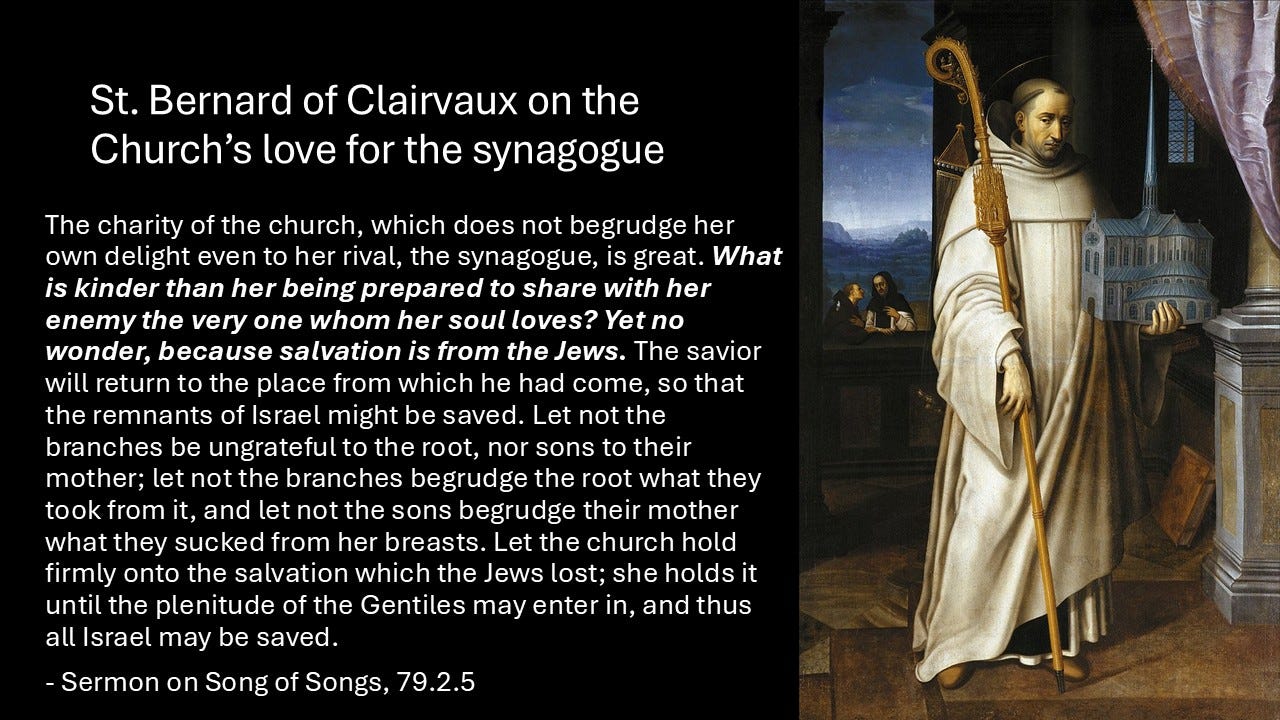
This is important though because while Justin might affirm these two points, many of his followers do not. Just look in the comments section and you will find people denying the witness doctrine and the future conversion of the Jews. Indeed, the letter from the students was opposed to these because it said the Jews exist purely in opposition to Christ. However, the traditional teaching is that they exist primarily as a living sign which points to Christ, even if there is an enmity between the brothers. This was the point I made by quoting St. Bernard of Clairvaux on the panel. God’s ongoing love to the Jews in spite of their infidelity is a very important part of the traditional teaching which is explicitly denied by many today, and this is what I have been pushing back on.
I think the key here is what is essential to Jewish identity and what is accidental in Romans 11:28. For the students, what is essential is their enmity with the Church, even if perhaps God might use them providentially as Justin would add. However, for myself (and I would argue for the tradition as well as the magisterium) what is essential is that they are the people to whom Christ is according to the flesh and hence were given special gifts (Rom 9:4-5), even if they have often been unfaithful to such a grand calling.
I posted an initial reply to Justin on X, and he brought up some additional objections I will reply to here:
The only pushback I would give at that point is to say that the unbelieving Jews are still not in a Covenant. A point that I have repeatedly made in my own work is that in both the Old and New Testaments the Covenant is oftern [sic] compared to an Olive Tree or Vine/Vineyard. Jesus is the Main Vine (John 15) of the Olive Tree (Romans 11) and like both chapters say, the unbelieving (Jews) are cut off. They can be regrafted, of course, and the promises remain, fulfilled in Christ, but it is clear that they are not a part of the Covenant of God while persisting in unbelief.
There is a breaking off the tree that must be considered. I agree here. But this was the point I was making about the sacramental economy and the transition from the Old Law to the New. It was only ever Christ who saved, and this is lost by the Jews in their rejection of Him. But there are also covenantal promises that remain to Jews.
If you agree with most of what I say here, the question then is why you defended speakers who used the formula to argue against supersessionism and mission?
I won’t speak for the others. He can ask them to clarify their own talks if they would like. It would be wrong of me to speak for them. On supersessionism, I already explained why I reject the label of supersessionism. On mission, I asked Ramage in the Q&A for his talk whether he sees the dialogue within Israel about the messiah which Ratzinger speaks about as calling for an important place for Hebrew Catholics such as myself, to which he replied affirmatively. I do agree the current formula of dialogue instead of mission to the Jews is misleading as it relies on a narrower definition of mission than is popularly used. Nonetheless, Ratzinger is clear that it is supposed to be a dialogue where we seek to get Israel to recognize Jesus as its messiah.
The whole work myself and others are doing with Hebrew Catholicism is to create a space within the Church for Israel secundum carnem to come into the Church without losing its national identity, as grace should perfect nature, not destroy it. Perhaps Justin disagrees with us on how this should be done. Would he object to something more simple though, such as simply translating the mass into Hebrew (which was approved by Pope Pius XII and led by Fr. Bruno Hussar who was involved with the drafting of Nostra aetate)? He recently pointed to Paul of Burgos as an example of a good convert from Judaism, but Paul encouraged things like Saturday prayer in remembrance of the Sabbath (although not observance of it) among his flock. The Lemann brothers also clearly still saw themselves as Jews in their writings and the Ratisbonne brothers made aliyah to base their mission to the Jews in Jerusalem (and this was before Zionism). It seems then Justin should limit his objection to particular Hebrew Catholic practices rather than the identity altogether. But this is a separate issue that cannot be fully addressed in this brief reply.
On Florence: it addresses those who ‘place their hope in legal observances as necessary for salvation’ — that is the covenantal order, not merely liturgical rubrics.
The word “legal” is literally in the sentence he quotes here.
On CCC 839: Romans 11:29 was read by Augustine himself as eschatological conversion, not present salvific efficacy.
Yes, but CCC 840 also refers to Jews as “God’s People of the Old Covenant,” referring to an ongoing covenant.
—
One issue that came up a number of times is about the extent of invincible ignorance. This is an issue that I plan to do more research on. It does seem to me that St. Alphonsus Ligouri extends invincible ignorance further than Justin does.
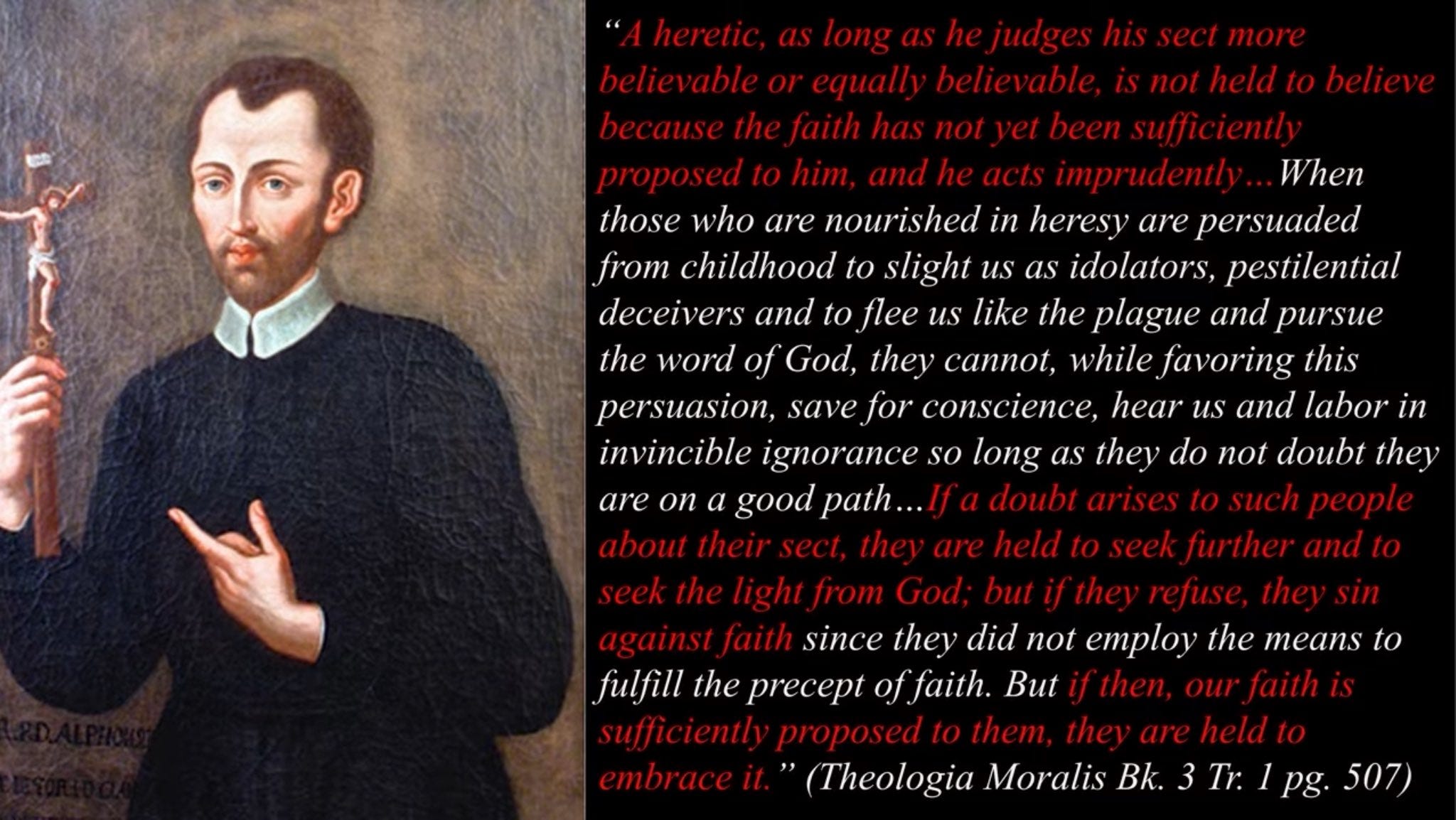
Most Orthodox Jews in my experience have not have the faith proposed to them sufficiently and flee from the Church due to things they have heard about us from childhood, such as to stay away from idolatry or that we are the forerunners of Hitler. So it seems to me that if they follow the revelation given to them and seek to follow God according to the best of what they know, perhaps God might send them an interior illumination upon the moment of death that Jesus is the messiah which would enable them to be saved. Nonetheless, I do agree we should not presume such things and ought to proclaim the gospel to all people, including Jews, and leave it to God to judge the hearts of men. The vast majority of Jews today are not even faithful to that part of revelation that has been given to them anyways. This is why I wish Justin and others like him would spend their time helping people like myself and other Hebrew Catholics to proclaim the gospel to our fellow Jews rather than wasting our time responding to fellow Catholics trying to bring us down.
I think Charles Journet (whose orthodoxy is widely recognized) gives a good treatment of the issue in relation to Jews in volume 3 of L’Église du Verbe incarné. Emmaus Academic will be putting out a professional translation of it soon, but here is a quick AI translation of the relevant passage:
2. The religious deviation of Judaism
1.
It results from a sin of infidelity by regression.
The old law was not rejected. On the contrary, one claimed to observe it. But one went astray by preferring the promises to the things promised, the preparation to the fulfillment, the means to the end.
As above—but even more so—it must be said that the men grouped under this religion are personally visited by divine grace.
If they consent to it, they can belong initially and salvifically to the true Church far more easily than members of pre-Christian religions.
One will then see them spontaneously give their hearts to the revelations of the Old Testament precisely insofar as these open mysteriously onto the New Testament.
One will see them, like the Hasidim, become passionately devoted to worship in spirit and truth, to the religion of divine love, to the promises of a spiritual salvation presented in the Cross to all men, and to an eschatology whose principal features coincide with the parousia announced by the Savior.
If, on the contrary, they resist prevenient graces, they may be taken over again by the temptation of infidelity by regression, by “Jewish infidelity,” which prefers the figure to the reality figured, the kingdom of this world to the Kingdom which is indeed in this world but not of this world.
Or else they may sin by desertion, like those Jews who no longer believe in the Bible or in their own prophets, or who even sink into atheism: they are then nothing more than wreckage.
2.
What must not be omitted when speaking of the religious deviation of Judaism is to add that this alone is radically insufficient to define the religion of all Israel.
It represents only one stage of Israel’s destiny.
From the theological point of view—and here the “theology of the history of salvation” is the competent discipline—it is impossible, without distorting all perspectives, to pass judgment on the religion of Israel without following it from the Old Testament, where it represents the supreme point of concentration of the true Church still in the process of becoming, then through the time of the tragic misunderstanding by which it failed to recognize the salvation of its Messiah, and finally up to the day of its reintegration, when it will come to take within the Church a place that has remained empty.
This was amazing! I'm really impressed at how charitable and even-handed you are in dealing with these criticisms. Not many people can discuss such a touchy subject in such a calm manner.
That a door has opened for a good-faith discussion between views on this issue is a huge step forward! Your conduct and response to what most would view as fuel on the flames in the Benedictine College flyers has been exemplary. Please keep the conversation going with Justin and others Gideon, as this is too important not to. God bless you brother.